Winning in a falling tide.
I first came across this chart about 15 years ago. It has stuck with me because it challenges the view that a rising tide lifts all ships and, by implication, that a falling tide lowers all.
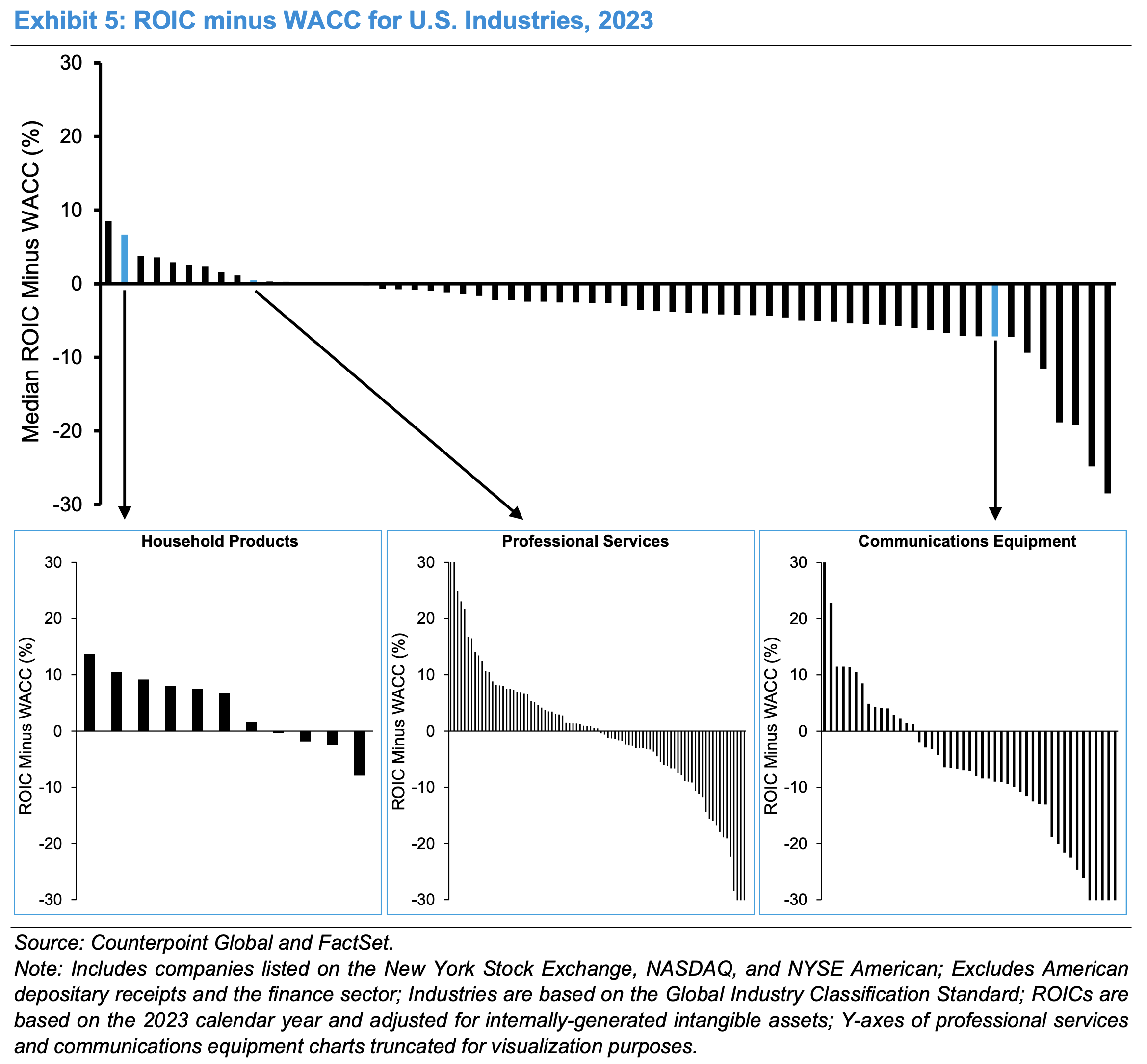
This chart shows a line-up of the return on capital for a range of US businesses across several sectors. The three smaller charts tell the interesting bit as the averages hide enormous variation in business performance. In sectors that are travelling exceptionally well, there are a significant number of businesses that are performing badly and vice versa.
The question of why some businesses in struggling sectors noticeably outperform their peers while others struggle has shaped much of my recent thinking about business. It’s become much more urgent over the past few years as the drinks sector, experiences both a cyclical and structural downturn. One part of the answer is competitive capability.
On the bottom right where the communication sector is overall negative, many businesses are winning outsized returns.
On the bottom left in the household products sector where most companies are making positive returns, many companies are failing.
When demand is growing, accidental competence can carry the day. Trade partners are willing to take risks, inventory is moving, customers are trading up, and price pressure is low. Mediocre marketing can be good enough. Just turning up can be enough if you are lucky.
In a falling tide, just being able to get in front of people is not a critical differentiator. The five-deep line-up at a tradeshow clamouring to taste your product has gone. The retail shelf space has tightened. Trade buyers are selective. Margins are tighter. On top of that, consumers may have changed too.
Suddenly an undifferentiated me-too marketing and sales model isn’t enough. Instead of just needing to get in front of the trade at a show or an event full of hungry tigers, producers are now finding their markets no longer reward participation; they reward capable execution.
When shelf space is contracting, you need to defend your space or be de-listed. To win more space, you must build a consumer connection that both impacts your bottom line and demonstrates to trade partners that you are worth working with. You need to displace someone less competent.
To succeed, the question is no longer “How do I find more customers?” but “How do I become better than the businesses I’m competing against?”
That’s part of the thinking behind BevSage. If capability is becoming a competitive advantage, SMEs should have affordable access to both tools and coaches that can help them succeed.
Figure reference: Counterpoint Global Insights (2024) Measuring the Moat: Assessing the Magnitude and Sustainability of Value Creation. Michael J. Mauboussin and Dan Callahan.