Can AI do your creative copy?
It is hard to get Large Language Models like ChatGPT, Gemini, and Claude to tell genuinely individual stories.
The figure below is from Artificial Hivemind: The Open-Ended Homogeneity of Language Models, which gave 25 different AI models the prompt “Write a metaphor about time” 50 times. That’s 1,250 prompts, bigger than a typical political opinion poll.
The models have been trained on an enormous proportion of publicly available human writing. The consequence is that, when asked to create without good guidance, they converge on the obvious.
The vast majority of model runs returned “river “as their metaphor. A smaller number produced “weaver”, and a very small number produced “sculptor” or something else.
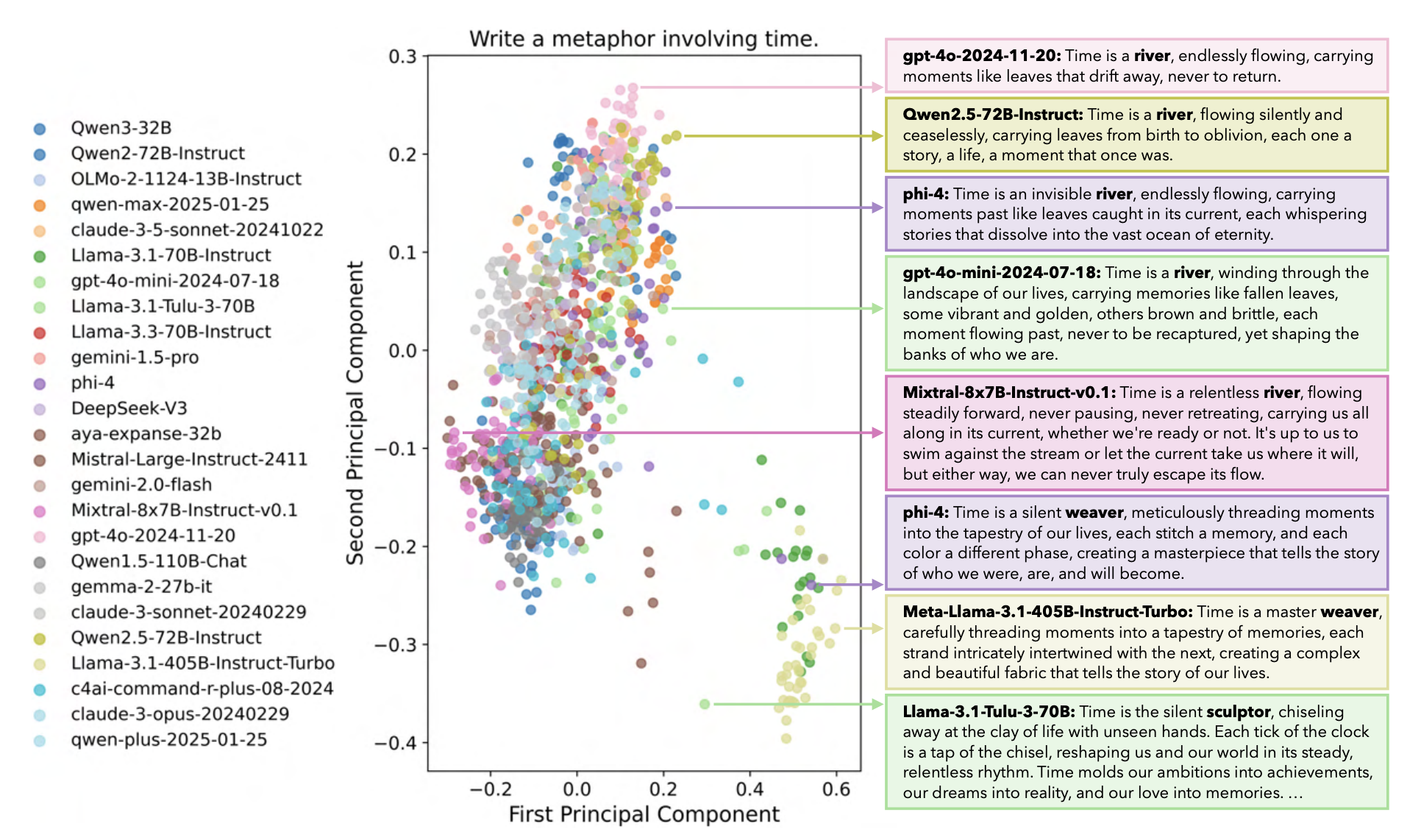
I did a test. To get a lot of metaphors for time into the model context, I asked it to research metaphors for time, and it came up with a list of dozens. I then asked it for a great metaphor for time based on its opinion – it chose sculptor.
If I ask an AI to find metaphors for time, it will find great ones. If I ask it to write one... it is much less impressive.
It’s bad news if you want to express your own voice. Very soon, everyone sounds the same, writing to the same audience of over-averaged bland conceptual personas.
This doesn’t mean AI can’t be a great help with writing, or that it can’t write. But it shouldn’t be trying to invent your voice. You should certainly be using it to help you plan social media campaigns. You need to set it up properly.
We have set up BevSage to support writing. Our Copywriting and social media posting manual and case study shows one way that you can configure BevSage up to support your writing and walks you through a process for building a library of target personas, a brand voice manual, and a folder prompt for campaign planning.
Once your voice and creative framework are built, AI becomes much better at expressing your individuality. The time potential savings and cognitive offload are huge. But the creativity must still come from your voice.
Reference
Liwei Jiang, Yuanjun Chai, Margaret Li, Mickel Liu, Raymond Fok, Nouha Dziri, Yulia Tsvetkov, Maarten Sap, Alon Albalak, Yejin Choi (2026) Artificial Hivemind: The Open-Ended Homogeneity of Language Models (and Beyond) https://arxiv.org/pdf/2510.22954